Strong Schools, Strong Community
This website serves as a resource for the information that was shared prior to the November 5, 2024 referendum vote. Should you have any questions, please contact the Superintendent, Aaron Tarnutzer, at tarnuta@mcfsd.org, 608-838-4550.
Final Referendum Results:
Yes: 56.8%, 4,830 votes
N0: 43.2%, 3,572 votes
According to final election results, voters have approved the operational referendum for the McFarland School District.
This approval allows the school district to continue to pay staff salaries and benefits in order to attract and retain high quality teachers for our students, as well as maintaining needed programming and manageable class sizes. Even with this approval, the district will continue to budget carefully and make difficult decisions in order to remain fiscally responsible.
The support of our community shows the commitment it has for its public education system. Thank you for the productive conversations we have had regarding the future of our schools and the students we serve. So many of you have been involved in important formal and informal roles in the process. We hope you will remain engaged as we continue to improve to better serve our students and community. Thank you!
Stay classy McFarland,
Aaron Tarnutzer, Superintendent
|
We held 3 information sessions. You can learn more here:
|
|
|
The McFarland School District has a strong tradition of being an essential part of our community with a reputation of success as we fulfill our mission of meeting the needs of every learner, every day. Whether you have students in school or not, our strong schools:
- enhance community stability and property values;
- increase community safety;
- create a more educated workforce; and
- boost the local economy.
Our district continues to face financial challenges due to the state underfunding public schools and the need for competitive pay due to a teacher shortage. Since the failed April 2, 2024 operational referendum, our district has addressed the reasons for the failure as follows:
| Reasons for Failure in April |
District Response |
| Too much money |
Reduced from $10.6 million in April to $5.25 million |
| Too long of a time |
Reduced from 5 years recurring to 3 years recurring
|
| Unclear how the $ will be spent |
Clear that $ will be used to pay staff salaries and benefits that maintain our current competitiveness to attract and retain staff. |
| Lack of community engagement |
Community Referendum Engagement group advised the board
Community Survey
Community Feedback meetings recorded and livestreamed
|
| Didn't make cuts before asking for $ |
Made difficult decisions resulting in $1.2 million in cuts ($700,000 was staffing) |
- Asks for the authority to exceed the revenue cap by up to $5.25 million phased in over 3 years
- Less than ½ the overall amount on the April referendum question
- Includes the $1.2 million in cuts made in the spring of 2024
- Increase is permanent (recurring) to catch up to current costs, which are not going down
- Will lead to stable funding for long-term financial planning for the district, community, and staff
- As the District has done in the past, they will not levy all of the $5.25 million if it is not needed
- Pay staff salaries and benefits that maintain our current competitiveness to attract and retain staff
- The starting pay will remain below the area average
- Has not kept pace with rising costs creating a statewide funding gap of over $3,000 per student
- State used one-time federal funds to fill in the gap. We used this funding for existing teachers
- State system is designed for districts to ask their community to fund schools through an operational referendum with a record 35% of WI districts doing so in 2024 alone
|
- The increase builds up each year for 3 years and then stays at up to $897 in the 3rd year and each year after that for a $400,000 property (39% of the April amount). Please note this amount includes updated information following the release of the final state aid amounts on October 15, 2024. The state aid amount was higher than expected resulting in a 28% reduction in the tax impact. Here is the math:
2024-25: total increase of $310
2025-26: total increase of $310 + $294 = $604. As you can see, the $310 from 2024-25 is already included in the $604.
2026-27: total increase of $604 + $293= $897
2027-28 and subsequent years: $897 + 0= $897
The total amount over your current tax bill stays at $897 for each year after that. It does not increase again.
On a $400,000 property value (including 7% increase in value each year)
| |
2024-25 |
2025-26 |
2026-27 |
2027-28 |
2028-29 and beyond |
| Updated Nov. referendum with state aid |
$310 |
$604 |
$897 |
$897 (no additional increase) |
$897 (no additional increase) |
| Initial Nov. referendum |
$404 |
$832 |
$1,247 |
$1,247 (no additional increase) |
$1,247 (no additional increase) |
| Failed April referendum |
$744 |
$1,128 |
$1,532 |
$1,971 |
$2,281 |
- Here is an example for a current McFarland home valued at $404,000
Current School Taxes: $2,453.40
2024-25: + $310 = $2,763.40
2025-26: + $604 = $3,057.40
2026-27: + $897 = $3,350.40
2027 and subsequent years: + $0 = $3,350.40
- McFarland school related taxes decreased 34% in the last 7 years are the 2nd lowest in Dane County
Find your Estimated Fair Market Property Value and review your previous school taxes at Access Dane
Estimated Incremental Property Tax Increase for above valued property
- 2024-2025: $0.00
- 2025-2026: $0.00
- 2026-2027: $0.00
- Accounts for 7% average annual growth to the estimated fair market property value starting in 2023-24 for the fiscal tax years of 2024-25, 2025-26 and 2026-27.
- Estimates were updated as of 10/15/2024 following the release of final 2024-2025 state aid figures. The total amount of the tax increase was reduced by 28%.
|
Along with other districts in Wisconsin, our district faces significant financial challenges including:
|
Watch this video to learn more about school funding
The state legislature has reduced funding for public schools in 2 main areas:
- State funding has not kept pace with increasing costs and inflation.
- The State used one time federal Covid relief money instead of state money to fund schools.
-
- State funding stopped being increased automatically with inflation in 2009 creating a gap between what it costs to educate a student and what funding is available.
- The federal Covid relief money is no longer available and the state funding did not increase to fill that gap. During the 2023-24 school year this money funded 31 of our existing teaching positions. These funds are no longer available resulting in a budget deficit.
- 86% of Wisconsin districts have asked their taxpayers to approve additional funding through an operational referendum. The state funding model is designed to force districts to ask local taxpayers to fund schools.
- State law limits the amount of money school districts can raise, known as the “revenue limit.” McFarland’s revenue limit is the lowest among neighboring districts as those districts have recently approved operational referendums. Our limit is about 20% below Monona Grove and Oregon. (See FAQ for more information).
It is getting hard and harder to attract and keep high-quality staff for 2 reasons:
- Our pay is not competitive compared to other area districts
- There is a teacher shortage
-
- Our pay is below the average among area districts.
- There are fewer teachers competing for more open positions and other districts are paying more after passing referendums.
- The current rate of pay for teachers in McFarland makes it difficult for them to live in the community.
- There are fewer people becoming teachers and 40% of new teachers leave the profession after six years, with pay being a main reason. (See this article, this news story, this news story, and the FAQ for more information).
In a recent McFarland staff survey, only 55% of staff feel pay practices are fair, leading some McFarland staff to seek higher pay elsewhere.
- When teachers leave it impacts student learning, staff culture, and increases costs related to onboarding new staff.
|
|
|
|
Please fill out our Budget Needs Questions form if you have a question that isn’t answered below.
click question to view answer
|
The district’s property tax mill rate (which corresponds to the school portion of local property taxes) has dropped by 34% from seven years ago. To see a historical breakdown of your property tax bill for the school, county, village, and technical college, visit the Access Dane website at accessdane.countyofdane.com/
Despite this decrease, taxpayers may find that their overall tax rate may have increased as taxes for schools account for only a portion of your total taxes. While the school tax rate has decreased, the Dane County and Village purpose taxes have increased notably. The rate shown below is the equalized tax rate per $1,000 of property value, referred to as the mill rate. Most people have seen a reduction in the actual dollar amount for the school portion of their property taxes. For example, when reviewing a 2018 and a 2023 tax bill for a McFarland resident the actual school taxes have decreased by $485 which is a 12% decrease. Of course, some could see an increase in actual tax dollars if the assessed value of their property has increased more than the average (sometimes due to additions or home renovations).
Please see the chart below showing the McFarland School District tax rate over the past 5 years for school purposes.
Each year on October 15th, the state finalizes its equalization aid distribution for school districts based on data from the previous year. For the fiscal year starting July 1, 2024, the McFarland School District is receiving $15,558,532 in state aid—an increase of $551,167 over the $15,007,365 originally projected. This increase has resulted in a reduction in school the tax levy for district residents and property owners.
The decrease in taxes is due to the inverse relationship between state aid and the local tax levy, which functions like a teeter-totter. When state aid increases, as it has in McFarland, the school tax levy decreases. It's important to note that additional state aid does not provide more spending power for the district; instead, it translates to lower taxes for local taxpayers.
As a result, the estimated tax impact of the upcoming November 5th operational referendum will be 28% less than originally anticipated. For a property valued at $400,000 in 2023/24, the estimated tax reductions are as follows:
- First year 24/25: $94 less. Instead of a $404 increase, the increase will now be $310.
- Second year 25/26: $134 less. Instead of an additional $428 increase, the increase will now be $294.
- Third year 26/27: $122 less. Instead of an additional $415 increase, the increase will now be $293.
These estimates take into account a projected annual property value increase of 7%. Therefore, instead of an estimated tax increase of $1,247 over three years, the district now expects the impact to be $897.
McFarland School District has the 2nd lowest school property tax on comparable homes in different districts. This was determined by using equalized value (Fair Market Value), and reviewing 11 parcels of homes in 11 different school districts the county (see below).
For instance, in 2023 the same home in Monona Grove paid over $1,000 more in school property taxes than that same home in McFarland School District. Verona was also $1,300 more than McFarland, while Wisconsin Heights, Sun Prairie, Madison, Oregon, De Forest and Waunakee were $400 to $600 more than McFarland. Only the Stoughton, Middleton Cross Plains and Mt. Horeb School Districts had similar school taxes for similar valued homes. Please note that the Stoughton Area School District just passed a referendum and taxes will increase for 2024.

The district will only tax (“levy”) for what is needed. This has been done in the past. For example, following a referendum approved by voters in 2004, the district levied a lower amount than it could have in 3 of the 4 years of the referendum. For example, in 2006-2007 the School Board could have levied $264,000 per the authority provided by the voters, but instead they levied $94,000 less than the full amount as it was not needed.
No. Should this recurring referendum be approved, the district will not be back in 3 years with another referendum asking to raise the revenue cap by another $5.25 million. The district is committed to doing everything we can to prevent ANY additional operational referendum at the end of 3 years.
One of the main advantages of a recurring referendum is that it is a longer term solution. A recurring referendum provides the district with 3 years to make budget adjustments including increasing revenues and decreasing expenses to account for any future gaps between expenses and revenues to prevent a fiscal cliff from happening again.
On the other hand, with a 3-year non-recurring referendum the district would need to ask voters to approve another operational referendum at the end of the 3 years as the authority to exceed the revenue cap by $5.25 million would end. This would result in a deficit or fiscal cliff.
Through the collaboration of the School Board, staff, and the referendum engagement group, the district has made the following budget reductions:
- $700,000 in reduced staffing: We are not filling positions for elementary school teachers, special education teachers, educational assistants, and library staff.
- $500,000 in other reductions: All departments will have at least a 10% cut in their budgets.
-
$49,000 was saved through reduced administrator pay increases including some administrators having no increase
-
While one of the goals of budget reductions was to minimize the impact on students, we know that it is impossible to make cuts of this magnitude without some impact on students.
-
Note that every $1 million in cuts is the equivalent of the salary and benefits of approximately 14 teaching positions.
These decisions were made using these guidelines:
- Impact on students: Prioritize those that have the least direct impact on student learning and well-being
- Long-lasting implications: Consider impacts on student enrollment, staff morale, community support, and sustainability of cuts
- Protect personnel: Whenever possible prioritize preserving jobs and retaining qualified staff members, using alternatives such as pausing in hiring, and attrition
Over the last three school years, school districts around the country received one-time federal funding to support operating costs related to responding to the COVID pandemic. During this time some states, including Wisconsin, chose to freeze the state contribution to school districts instead of making annual inflationary increases.
As those one-time, time-bound funds come to an end in 2024, McFarland and other districts are facing a dramatic reduction in revenue referred to as a “fiscal cliff.” The result is a large gap between the actual cost of operating a district and the funding received from the state. The state funding system was designed for districts to use the funds in this manner and then ask their taxpayers to approve an operational referendum to make up the difference.
In 2023-24, McFarland used the one-time federal funds to pay for 31 teachers who were already on staff, and as that funding comes to an end, and in the absence of changes to school funding at the state level, the district needs to fill that gap with a combination of cost savings, increasing revenues, district savings (fund balance) and a potential referendum question.
While the district did make some budget cuts, there are only so many cuts the district can make before it is no longer able to operate and provide a quality education. In addition, it was expected that the state would increase funding to make up for it.
During the 2021-22, 2022-23, and 2023-24 fiscal years, Wisconsin used federal COVID money instead of state money to fund schools. When the state didn't increase funding enough to cover rising costs due to inflation, school districts faced large budget deficits, often called "fiscal cliffs," after the federal money was spent.
McFarland used the federal money to pay the salaries and benefits of 31 existing staff members. This helped reduce school taxes and delayed the need for an operating referendum by one year, compared to our neighboring districts.
The school board chose a recurring referendum (see descriptions below) because it:
- Accounts for our current budget deficit that is due to increased costs that are not going down.
- Prevents a future budget cliff when the referendum ends.
- Provides for a longer term solution to a long term budget problem.
- Allows for flexibility as the district does not need to tax for the total amount if things change.
- Provides stability for staff, families, and community members, so they can plan ahead.
Both a recurring and a non-recurring operational referendum increase the amount of money the district can receive from taxpayers.
A non-recurring referendum raises the tax levy for a certain number of years and then ends. The advantage of this type of referendum is that it allows for changes to be made in the amount if the funding and budget situation changes. The disadvantage is that it does not provide stability for the district as there would be a significant decrease in revenue to the district or a fiscal cliff at the end of the referendum. This typically requires the district to ask voters to approve another referendum for as much or more than the original referendum as expenses rarely decrease due to inflation and other factors. As a result, a non-recurring referendum is viewed as a short term solution.
A recurring referendum raises the tax levy and this amount is added to the district’s base revenue and carries forward forever. The advantage of this type of referendum is that it provides stable funding for the district especially given that expenses will continue to rise over time. This stability improves staff retention and allows for district budget planning. A disadvantage is that it does not provide for flexibility should the funding and budget needs change. In addition, if future funding does not keep up with budget needs, districts may need to have another operational referendum; however, that amount is much less than if the referendum were non-recurring. As a result, a recurring referendum is viewed as a longer term solution that provides more stability to district funding.
As you can see from the chart below, McFarland pay falls below the average pay in Dane County for all years of experience ranges except years 16-20. Here are a few other takeaways from this data:
- On average, McFarland teacher pay was 3.7% below the Dane Cty average regardless of years of experience. When the data is available for this school year we'll likely see that gap widen since many districts have passed referendums and will be able to provide increases much steeper than ours.
- 71% of McFarland teachers made an annualized salary that is below the Dane Cty average ($63,906), regardless of years of experience.
- Early career teachers with 0-3 years of experience are behind in annual pay $1,077
- Our most experienced teachers are the furthest behind our competitors with a $4,372 annual pay gap, on average.
- Only teachers with 11 or more years of experience or more make a living wage when compared to the MIT living wage calculator for Madison, WI (data is for 2 adult working households with two children).

Another way to compare districts is to look at starting pay for a teacher that has a Bachelor's (BA) or a Master’s (MA) degree. You can see data below that McFarland is low in starting pay for those with a BA (tied for 9th out of 12) and a MA (10th out of 12) for 2023-24.

Here are the preliminary salaries for 2024-25 based on data available at this time:

A passed referendum would be used to:
The district is constantly looking for ways to save money. Some of the many examples of the ongoing processes the district uses include:
- Fund balance: By maintaining an adequate fund balance (similar to a savings account) we are able to pay our bills without having to borrow money from the bank (“short term borrowing") and even earn interest ($450,000 last year!)
- Energy: reducing consumption through tracking and scheduling software that monitors and controls HVAC systems, so they don’t operate when they don’t need to, purchases natural gas on the open market when pricing is better, utilizing energy efficient products
- Supplies, materials, technology (all departments): lower costs by purchasing in bulk, purchasing with other groups (consortiums), use state contract prices when lower, technology uses a 5-year budget planning to maximize its use of Federal Erate funding that can reduce our costs on Network Hardware by up to 40%
- Insurance: uses an insurance broker to get long term deals for health and dental insurance (we will be bidding health insurance for the 25-26 Fiscal Year)
- Grants: uses grants to fund expenses instead of using taxpayer money
- Reselling gently used items
- User fees for facilities
- In-house training versus using outside trainers
- Using consultants versus ongoing employees when it saves $ to do so
- Milling donated wood for student projects versus purchasing wood
- Using revenues from the student led Spartan Manufacturing to purchase equipment
- Using volunteers versus paid staff when appropriate
It can be misleading to compare recent referendums from other districts as many have previous operational referendums that are still part of their budget. These previous referendums can reduce the amount for the most recent referendum.
The Stoughton, Monona Grove, and Oregon School Districts have all passed operational referendums in the last 2 years. All 3 referendums were recurring. Stoughton’s referendum was for 4 years and Monona Grove and Oregon’s referendums were for 3 years.
If you take the amount for 3 years, the total amount of increase after 3 years are:
- Stoughton (April 2024): $1,596 per $400,000 of property value
- Monona Grove (April 2023): $1,336 per $400,000 of property value
- Oregon (November 2022): $1,036 per $400,000 of property value
- McFarland (November 2024): $897 per $400,000 of property value
Without a referendum the district will need to cut positions and reduce staff pay. For every $1 million the equivalent of the salary and benefits of 14 teaching positions would need to be cut. For the 2024-25 school year the $2.5 million deficit is the equivalent of 36 positions, which is 17% of our professional staff. Additional cuts would need to be made in future years due to increases in costs.
Please note that this includes the $1.2 million in cuts that were already made for the 2024-25 school year.
It is possible that student enrollment will decrease as students choose to attend other districts due to cuts that impact the quality of the education they receive. If this happens, additional cuts will need to be made to account for the reduced enrollment.
Overall, strong schools contribute to a thriving, safer, and more prosperous community, including:
-
Enhancing community stability and property values.
-
Increasing community safety.
-
Creating a more educated workforce
-
Boosting the local economy.
The salary increases are more than the tax increase. Past and planned increases in salary for professional staff in 2023-24 and 2024-25 had increases that were minimally $1,500. The referendum would result in at least a $1,500 increase per year for professional staff meaning an increase of $1,500 in year 1, $3,000 in year 2, $4,500 in year 3. The tax increases for the referendum are estimated to have an annual increase in property taxes on a property valued at $400,000 of $310 in year 1, $604 in year 2, and $897 in year 3.
McFarland’s referendums include:
- April 2, 2024 Operational Referendum, Recurring, 5 year, total of $10.6 million- Failed (59% to 41%)
- November 8, 2016, Capital and Operational Referendums
- Capital (remodeling and new construction), $65,150,000- Passed (66% to 34%)
- Operational Costs, Recurring, 2 year, total of $232,000- Passed (64% to 36%)
- Operational Costs, Recurring, 3 year, total of $1.1 million- Passed (68% to 32%)
- March 16, 2004, Operational Costs, Recurring, 5 years, $1.5 million- Passed (52% to 48%)
- November 4, 1997, Capital and Operational Referendums
- Capital (new elementary school) $11,385,000- Passed (61% to 39%)
- Operational Costs, Recurring, $384,000- Passed (57% to 43%)
- May 20, 1997, Capital (remodeling and new construction) $16,040,000- Passed (56% to 44%)
The fund balance is similar to a savings account for the district. The main use of a fund balance for cash flow as the district’s bills become due before the district receives revenues. Without an adequate fund balance the district has to borrow money from a bank to pay the bills resulting in additional expenses for interest. Our district must maintain at least $10.6 million to avoid the interest expenses related to short term borrowing. A fund balance is also used for emergencies and larger projects.
A significant advantage of a healthy fund balance is that it earns interest. For McFarland, this year our fund balance earned the district $450,000 and was used for operational expenses such as salaries and benefits which decreased the tax burden for the community.
Our current fund balance is $13.6 million and some of these funds will be used to fill the budget deficit. Without a change in funding such as a referendum, the district fund balance will be depleted in 3 years.
Additional fund balance notes include:
- Defined in our board policy and has recommendations from DPI for levels
- Used to invest to create investment income to afford ongoing operational expenses
- Used to show to the Bond Market that we are financially stable which helps with Capital Initiatives
- Used in emergencies
In Wisconsin, there are two types of school referendums: operational and capital (bond).
An operational referendum asks voters for permission to increase the school portion of property taxes for the purpose of increasing revenue to fund day-to-day operations, such as staff levels and resulting class sizes, class offerings, and other current programming and operations.
A capital referendum (bond) or facilities referendum allows a district to increase the school portion of property taxes to support major renovation or construction projects for district facilities. This is the type of referendum that was approved by MSD voters in 2016 to renovate school buildings. The district borrows money (bonding) and pays it back including the principal and the interest. These payments are spread out over a number of years, which also distributes the tax impact over years.
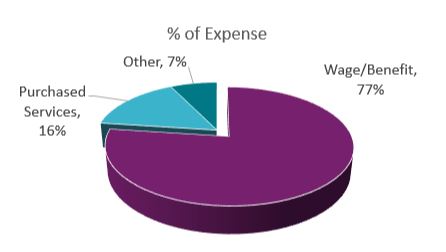
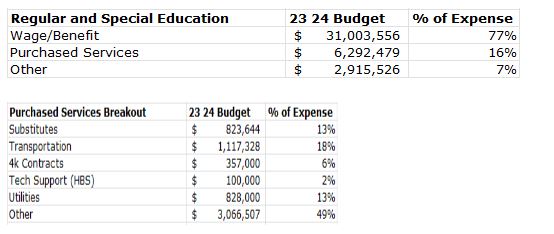
District wages and benefits account for 77% or $31 million of the budget.
When combined with those purchased services that are direct services for students such as substitutes, transportation, 4k teacher contracts and third party technology support, 83% of district expenses are related to compensation for services for students.
Most of the rest of the budget is fixed costs with very little wiggle room for cutting…things like insurance, technology hardware, utilities… You think of things that you would also have in a normal household…electricity, water, internet…but this household is just about 1 million square feet.
Other:
- The Regular and Special Education "Other" category, which accounts for 7% or $2.9 million of budget includes expenses related to supplies, equipment, textbooks, maintenance equipment replacements, vehicle replacements, leases, liability, property insurance and workers compensation insurance.
- Purchased Services account for 16% of the total budget with the "Purchased Services Other" category accounting for $3 million or 49% of the purchased services budget, includes construction, cleaning, payments to other school districts for shared services, payments for grant partnerships, state payments, private student placements, legal services, and audit services. For more detailed information including a 11-year expense and revenue history of the district, please see the resources section on our budget needs page.
The 2016 referendum that was approved by 66% of the voters gave the district permission to borrow $65 million to give students, families, and the community safe, accessible, and properly sized buildings with longer lifespans. As you can see below, 71% of this project involved improvements to educational spaces used on a daily basis throughout the school year.
The project began in 2011 with 2 sets of facility studies. In 2014 over 400 community members petitioned the school board to move forward with facilities improvement based on the results of the studies and there was significant community input through the process.
The project was well-timed due to low interest rates, construction costs, and a lower tax impact due to previous debt falling off in 2017. This process and project preceded an unimaginable pandemic, minimal increases in state funding and the highest levels of inflation in 40 years.
The projects, listed in order of expense, included:
MHS Building wide HVAC system upgrades, Student Learning Center addition, Business and Marketing Center, and Technology Education Space Renovations for trade education (25 % of total funds).
- These spaces were not large enough for the growing use by students nor designed for the current instructional needs of students involved in these programs of engineering, family consumer sciences, construction trades and automotive/engine career tracks.
CEPS Combined 2 buildings into (24% of total funds).
- The primary school had structural, accessibility, safety issues and mechanical problems. Having two buildings next to each other caused inefficiencies including costs for duplicate staffing.
IMMS Classroom/Gym Renovation (20% of total funds).
- The school was built too small for the number of students with undersized classrooms and the gym.
Performing Arts Center (13% of total funds)
- It was not accessible to those with disabilities, could not accommodate half of the high school student body, and had failing sound/technology. This space is now accessible and regularly used by students, the community, and outside groups (who pay user fees).
Pool (12% of total funds)
- The 36-year-old facility was leaking water, had unrepairable mechanical systems requiring $4 million in repairs. It was not accessible to all community members including those with special needs and senior citizens, was too small for the amount of use, lacked a community locker room, and lacked seating for spectators. In 2023, the pool served 21,000 more people than in 2016 and hosted large events benefiting local businesses.
Athletic/Phy Ed/Community Recreation: Track, Stadium Field, Baseball Fields (4% of total funds).
- Track: The track base and surface needed replacement and the stadium irrigation system and drainage system needed replacement.
- Field: After significant study, a synthetic field (Astroturf) was chosen to better handle multiple sports and physical education classes and to reduce maintenance costs. The new surface repaid its initial cost in 7 years by saving on maintenance including cutting 1 full time maintenance position related to the field. The new field is used more consistently than a natural surface as it can handle the use. It has hosted large events, benefiting local businesses.
- Baseball Field: To accommodate the new pool and auditorium, and serve the community with better parking for the stadium, the district used land it already owned to replace 1 field with two fields to allow JV and V to compete at the same time, similar to girls softball. These fields are also used for Community Recreation programming for youth sports such as flag football, soccer and other youth sports.
WIS: Adding a multi-purpose room (2% of total funds).
- Multi-purpose room: Added to accommodate large student groups (e.g. Orchestra, grade level presentations), staff meetings, and community events.
For more information see this document from 2016.
The school districts of Monona Grove, and Oregon, have higher per student revenue cap limit spending authority because their community voters approved operational referendums. These referendums were done to replace federal one time funding that districts were given to continue operational expenses and also address inflationary costs for salaries and benefits for existing staff.
MSD has the second-lowest funding per student in Dane County. Verona, at $15,310 per student has the highest and is $3,264 more per student due to operational referendums than MSD. In the April 2, 2024, operational referendum the district asked for an additional $1,598 above our current level of $12,046 per student for 24-25 to maintain educational programming.
Last year athletics cost about $400,000 per year (expenses minus fees and admissions), and clubs cost about $60,000 per year. For next year, we've cut costs by 10% in these areas and are always looking for ways to save money. We are increasing user fees for the 2024-25 school year, but we already have some of the highest fees in our conference.
These programs benefit students, and if we cut them students might leave for other districts that offer these activities. Last year at the high school 459 students (60% of all students) participated in at least 1 sport. If 38 students left, we would lose the $460,000 in savings because each student brings in $12,000. Also, not having sports events would hurt local businesses that get visitors from other communities.
It is important to review the need and salaries for all positions, including administrators. For the 2024-25 school year, some administrators had their pay increases reduced or frozen, saving $49,000.
When administrative staff leave, their positions are evaluated to see if they need to be replaced. Our administrative staff have taken on extra duties instead of adding new staff. If positions are cut, someone else would have to take on these extra responsibilities.
The district has the following administrative positions:
-
1 Principal at each building (4 total)
-
1 shared Assistant Principal for CEPS and WIS (this is a reduction of 1 position from 2023-24) 1 at IMMS, and 2 at the high school (4 total)
-
1 Superintendent, who also serves as the Communications Director and Human Resources Co-Director
-
1 Director of Business, who also serves as the Technology Director, Transportation Director, and Human Resources Co-Director
-
1 Director of Student Services, who also serves as the Special Education Director, Health Director, English Language Learner Director, and Homeless Liaison
-
1 Director of Teaching and Learning, who also serves as the Data/Assessment Coordinator, Advanced Learning Coordinator, and Summer School Director
-
1 Director of Buildings and Grounds
-
1 Director of Food Service
Our administrators work more days than other staff (50 more days or 11 months for Associate Principals, 70 more days or 12 months for other administrators). They are usually paid less than the area average. For example, our superintendent is paid the least among local districts (behind Mount Horeb), Just like teachers, there is a shortage of quality administrators, so we try to offer competitive salaries to attract and keep staff.
Whether your taxes go up as your property value goes up depends on how much your property value increases compared to others. Property values determine how the total tax amount is divided among taxpayers.
We agree that using operational referendums to fund schools is not a long-term solution. We are advocating for the state to create a system that doesn't rely on local property taxpayers. We encourage you to contact your legislators and do the same.
The legislature has underfunded public schools through state taxes and directed schools to use operational referendums. Until the state changes the funding model, we are focusing on addressing our budget deficit for next year and the following years. This includes continuing and adding to the $1.2 million in cuts made this spring and considering an operational referendum.
As shown in the graph below, our student enrollment has been fairly steady at around 2,450 students each year. Birth rate data shows that enrollment will decrease by about 100 students over the next few years, bringing the total to around 2,350 students.
This follows a trend across the state. In 2022-23 71% of Wisconsin districts experienced declining enrollment largely due to a decline in births including a 17% decline between 2007 and 2022.

A decrease of 100 students would mean about $1.2 million less per year in revenue. The School Board is thinking about allowing more open enrollment spots in certain grades to keep our current enrollment levels in the 25-26 school year.
The enrollment graph does not include students in Wisconsin Virtual Academies (WVA), our district's online charter schools. Tax increase funds will not be used for WVA operations or staffing.
When students from other districts enroll in McFarland, it brings in about $9,000 per student. The district gets about $12,000 for each resident student, so it’s better to increase resident enrollment. However, open enrollment also helps our budget.
The district is finding ways to bring in more money. This year, increasing student fees will bring in about $46,000 more. We're also thinking about raising fees for using facilities like the Performing Arts Center. We apply for and get a lot of grants, but we can only apply for the ones we qualify for. Some grants go to districts with more students who need help because of their families' money situations.
Outside of special education, which changes based on student needs, the district added 6 new positions in the 2023-24 school year.
We added 5 positions in student services (like counselors, psychologists, and social workers) to help with school attendance, engagement, and mental health. Even with these new positions, we still don't have enough staff based on what is recommended for how many students we have. Our students need more help in these areas as time goes on.
We also added a Diversity, Equity, Inclusion, and Belonging Coordinator. More details about this position are explained below.
Like all positions, the district will continue to evaluate the need for the Diversity, Equity, Inclusion, and Belonging Coordinator position that was added at the start of the 2023-24 school year. This position was planned for many years based on student achievement data for students of lower socio-economic status, students with special needs, and students of color. The strategic plan that was made by a committee of community members working with the district said this was a priority as part of the mission to meet the needs of every learner every day in pursuit of the vision of an equitable and inclusive community committed to student belonging, achievement, and growth. The position is being paid for in part by cutting 3 other jobs that were leading this work in the district. We will keep evaluating the need for the position based on if students do better academically in school and feel like they belong.
A resounding message after the failed referendum in April and in the recent referendum survey is that more collaboration is needed between the village as taxpayers are feeling the total increase in taxes between the village and what the district is asking for is too much. The district and the village have increased their collaboration and are talking openly about how to recognize this challenge when making funding decisions.
The district and village collaborate on many joint projects to save taxpayers $ at a level that has not occurred before. For example, the two entities combined efforts to upgrade the needs at Waubesa Intermediate School to address the needs both had with a new park that was proposed by the Village, one block away, and the district needing to replace the old playground equipment at the school. This saved a combined $1 million to avoid duplicated parking, shelter, and playground space that can be used by the community members and school students. Additionally, the district and village have collaborated on a Solar Farm located on Siggelkow Road with Alliant Energy. When operational, it will generate new revenues that the district and village can put back into more energy savings.
The amount of money requested increases each year to minimize the tax impact to taxpayers. The district will use reserves (“fund balance”) and other budget adjustments each year to make up the difference in expenses and costs.
Tax Increment Financing (TIF) is an economic development tool used by municipalities to promote economic development and redevelopment initiatives within a defined area called the Tax Increment District. Wisconsin adopted TIF legislation in 1975.
In a TID, the current taxes paid to entities like the school district are based on the assessed value of the land and buildings when the TID is created and continue to be paid on an annual basis over the life of the TID. As the TID increases in value, the tax increment value (new value minus the original value) is taxed, and this tax increment revenue is used by the municipality to pay for improvements like roads, sewer, and water systems in the TID necessary to support the new development. Once the TID closes (e.g. up to 20 years later), all taxing entities, including the school district, realizes the benefits of the new tax increment value.
A school district representative is on the TID Joint Review Board, which has final approval authority over the creation or amendment of a TID. To learn more, please see this TIF Page the village created.
Maximizing the use of community resources is so important. As a school district, we are committed to providing opportunities for the community to use school facilities. There are many examples of this such as the McFarland Activities and Play program and the Angie O'Donnell Aquatic Center that has activities for people of all ages. You can learn more with this document: LINK.
In addition, school spaces are also used by community groups and for onsite after school care. We will continue to look for opportunities to expand these efforts and welcome your ideas!
The district has a few options to reduce expenses and increase revenue for transportation including adjusting walk zones and changes to the private pay (“buy a seat”) program.
Walk zones:
- Wisconsin State Statute requires that public schools provide an opportunity for bus transportation to any student who lives 2 or more miles from their school. For safety reasons many districts, including McFarland, provide transportation to students within 2 miles.
- Prior to 2017-18 our walk zones were 2 miles for all k-12 students
- In 2017-18, the District began providing transportation to all students in grades K-2 as the construction and renovation of CEPS did not leave much space for families to safely drop off nor pick up students for 18 months. The District also changed the walk zone for students in grades 3-5 to 1 mile or more as it was/is considered best practice for the safety of students that age and our neighboring districts already had such a practice.
- Once construction was completed the District kept the no-walk zone for grades K-2 for safety reasons and based on the positive experience for students as a result of the change in 2017-18.
- Given the current budget deficit, the District is exploring increasing student walk zones to reduce expenses.
Private pay ("buy a seat')
- Students who live within the walk zone are currently able to pay for transportation. Prior to 2017-18, the cost for private pay was $360.
- When the District decreased the walk zones in 2017-18 the cost was reduced to $100 as there were so few K-5 students who were outside of the walk zone. In addition, the District only offered this option if there was an existing bus route that had space and the route did not need a special pickup for that student. Essentially, the District if filling up existing busses on existing routes. As a result, it doesn't cost the District anything extra other than the time spent picking up the student. All the fees result in additional revenue.
- Given the current budget deficit, the District doubled the private pay fee for 2024-25 from $100 to $200. While a larger increase was considered, it was felt that doubling the fee was a significant increase on short notice.
- The District is exploring increasing the fee or eliminating this program for 2025-26 to increase revenue.
- There are currently about 100 students that participate in this program.
A Referendum Engagement Group consisting of 28 community members representing a variety of perspectives and experiences across the community volunteered to help explore the solutions to the district’s budget needs over the course of three sets of meetings in May. The group included self-described “no” and “yes” voters on the April 2nd referendum with all members being committed to finding solutions that are best for the community, students, and staff.
During the meetings so far the group has focused on understanding why the referendum did not pass, analyzing the funding needs of all Wisconsin school districts including McFarland, identifying potential cuts and ways to increase revenue, and exploring the potential of a revised referendum in November. Based on what they have heard from their fellow community members, the group feels the main reason the referendum didn’t pass is that the amount of money was just too much and for too long of a time period at a time when people are struggling due to other increased expenses.
The group guided the district in the design of a survey that will be sent in the mail to all residents in the McFarland School District, staff, and parents/guardians. The survey will ask people to share their thoughts on three options for a potential November referendum as well as other areas of the district budget and operations. The community group will convene after survey results are collected to review responses and make recommendations to the McFarland School Board. If the school board decides to pursue a referendum question on the November ballot, they would need to make that decision by August 27th.
You can learn more about this group in an article published in the McFarland Thistle by clicking here.
These projects were completed after many years of planning and were necessary due to failing playground equipment at WIS, failing pavement at the WIS parking lot, and the lack of needed bathrooms/storage for HS and youth girls softball.
For the playground and inclusive park specifically, in early 2021, Village and School Administration met to discuss two parallel projects that were being independently planned by both governments. The Village had a plan for an inclusive park one block from WIS and the district had plans for a new playground and a structure for bathrooms/storage and concession for softball. These bathrooms were important for many reasons including to be consistent with the baseball facilities as it relates to equitable access per Title IX. We realized that the village and district would be duplicating each other. This joint project saved over $1 million between both organizations. Both entities used one time capital and grant funds to complete this project.
It is important that the district look at all options to save money. Transitioning to a 4-day school week takes a few years given all the moving pieces and the careful planning that is needed. As a result, transitioning to such a model would not address current funding needs.
In addition, the research for a 4 day school week has found that despite what we would assume, it only saves one to two percent. While it saves on the cost to run a facility and transportation for the day, the majority of a school budget is for staff expenses and these don’t change. There are mixed results for academic outcomes.
You can read this article for an article on this research.
Since becoming the host district for the Wisconsin Virtual Academies in 2009-10, the district has received $12 million in revenue, including over $1.6 million in 2023-24.
Here are some highlights of this relationship:
- In 2007 the district began exploring options on how it could bring new revenue into the school district without impact to our taxpayers to offset inflationary costs.
- In 2009-2010, the McFarland School District negotiated with a Non-instrumentality Charter School, now called the Wisconsin Virtual Academies (WVA). A Non-instrumentality Charter School is a school that is given permission from the host school district to operate a separate school board, separate staff, separate business operations and separate financial books.
- The school district retains 5% of every dollar WVA receives from other school districts across the state via the School Choice Program (Open Enrollment).
- This has provided the district with a revenue source that has been used to help balance our district budget since 2009-2010.
- Without WVA the district would have to reduce our budget including staffing and programming or ask for more revenue cap authority via a larger referendum.
- The district is budgeting for $1.4 million in revenue from WVA in 2024-25. This amount could be more or less depending upon WVA enrollment.
- WVA is the largest non-instrumentality virtual charter school in the state with an enrollment of over 4,400 students.
- You can see the $12 million in revenues since 2009-10 in this chart:

Currently, the state of Wisconsin reimburses public school districts for 33% of the cost for special education services, while voucher schools are reimbursed for 90% of these costs.
For the 2024 fiscal year, the state reimbursed McFarland $1.9 million of the $5.9 Million in expenses.
These costs have increased dramatically. There has been an 84% increase in special education costs since 2009 (average of 6% per year) without a corresponding increase in funding.
If the State would fund 60% of eligible costs as proposed in 2023 via AB43/SB 70, McFarland would receive another $1.7 million in state special education funding reducing the amount of money that is transferred from the local taxpayer funded General Fund. To learn more about sped funding, please see the following link
|
Do you have a question not answered above?
Submit your question here!
|
|
|
